HBM4E eLearning Course
Let MindShare Bring "HBM4E" to Life for You
HBM4E eLearning Course
Instructor(s): John Swindle
Equivalent of: 4-day course
Subscription Length: 120 days
$1595
Course price
We can create a live corporate training for you:
What's Included
 |
 |
 |
| HBM eLearning modules (unlimited access for 120 days) |
PDF of Course Slides (yours to keep, does not expire) |
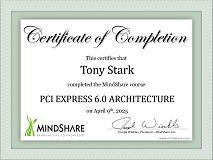
Course Completion Certificate (boost your resume/CV) |
Purchasing this HBM eLearning course will provide the materials shown above, but also includes the Fundamentals of DRAM eLearning course.
You Will Learn
- DRAM architecture fundamentals
- Where JEDEC expects HBM to be placed in a system
- Organization and operation of HBM devices
- Electrical characteristics of HBM and why HBM lacks many SI tools found in other technologies
- Differences between WideIO, WideIO2, HBM1, HBM2, HBM2E, HBM3, HBM3E, HBM4 and HBM4E
- HBM3/HBM3E/HBM4/HBM4E bank state machine, commands and waveforms
- Overview of IEEE 1500
- Calibration and training of HBM channels
- HBM power management
- HBM error handling
Course Description
High Bandwidth Memory (HBM) is a form of DRAM used on the most capable HPC and SoC platforms. HBM is an evolution of WideIO and WideIO2 with some concepts borrowed from Graphics DRAM. HBM provides the maximum possible bandwidth of any DRAM technology, largely by implementing several very wide channels. All DRAM (PC DRAM, LP DRAM, Graphics DRAM, HBM) are very similar to one another, but there are significant differences in HBM that this course covers in detail up to and including HBM4E.
Course Topics:
- Fundamentals of DRAM eLearning Course (included)
- System Architecture and Intro to DRAM
- DRAM Device Architecture
- Packaging and HBM
- DRAM Controller Basics and Addresses
- DDR4 Device and Pin Descriptions
- Signal Routing
- DDR4 - Bank State Machines, Commands and Waveforms
- Refresh
- HBM eLearning Course
- System Architecture and Packaging
- Example Platforms
- Channel Architecture, Device Organization and Device Architecture
- Features and Architectures of Previous Technologies (PC and LP DRAMs)
- HBM Channels and Pseudo channels
- Signal Descriptions
- Channel Signals
- Global Signals
- Bank State Machines, Commands and Waveforms
- Simultaneous Row and Column Commands
- Use of WDQS and RDQS
- Refresh
- Auto Refresh
- Self Refresh
- Single-bank (Per-bank) Refresh
- Row Hammer, Target Row Refresh and Refresh Management
- Electrical Specifications
- Why so many traditional SI tools (ODT, ZQ cal, etc.) are not present
- IDD Specification
- Power Management
- Power Down
- Clock Throttling
- Initialization, Calibration, and Training
- JEDEC Initialization
- Mode Registers
- Initialization Steps
- Calibration and Training
- Vref Training
- Loopback LFSR MISR Training
- Command Bus (AWORD) Training
- Data Group (DWORD) Training
- Duty Cycle Adjustment (DCA) and Duty Cycle Monitoring (DCM)
- WDQS Interval Oscillator
- JEDEC Initialization
- Errors and Error Handling
- Temperature
- Address Parity
- Data Parity
- Lane Remapping
- Sideband ECC
- On-Die ECC
- Post Package Repair
- Self-Repair
- Hard and Soft Repair
- Overview of IEEE 1500
- System Architecture and Packaging
Course Content
28min to complete
33min to complete
Recommended Prerequisites
Basic knowledge of digital design and computer architecture is recommended
Benefits of eLearning
Access to the Instructor
Ask questions to the MindShare Instructor that taught the course
Cost Effective
Get the same information delivered in a live MindShare class at a fraction of the cost
Available 24/7
MindShare eLearning courses are available when and where you need them
Learn at Your Pace
MindShare eLearning courses are self-paced, so you can process when you're ready